Thursday, June 27, 2013

Erudite Euler

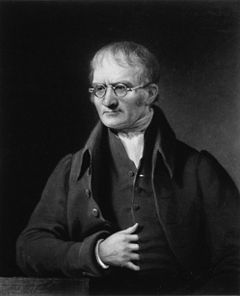
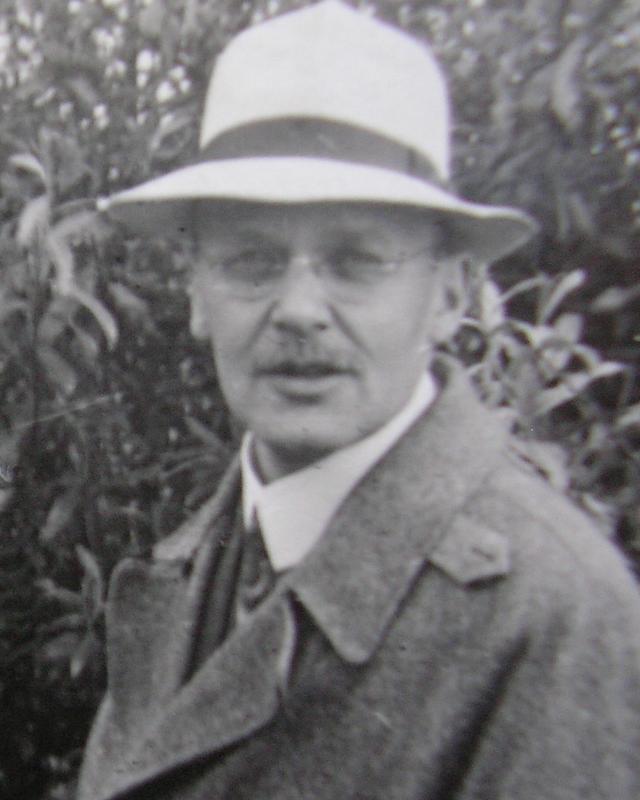
Leonhard Euler (1707-1783)
Up this week is Euler, the great mathematician. It is impossible for me to do him justice in this post, because of the shear volume of his work and my lack of knowledge about mathematics. If you would like to read more about him, please look at some of the articles in the references. These ones are particularly good.

I mostly know of Euler from two things-Euler's method, which was an approximation method I used in calculus, and Euler's formula, which could actually mean many things, but in this case I refer to his formula that relates exponential and trigonometric functions, eix = cos(x) + isin(x), and is perhaps seen more commonly in less scientific circles in the particular form where x = π, where it simplifies to eiπ = 1. These are both definitely important, and I used the latter in about every other homework that I did this year, but Euler considered many more applied problems than this small sample size would suggest.

Leonhard Euler was the son of a minister and originally intended to study theology. Fields of study were different in the 18th century, though, and at the conclusion of his master's degree he gave a lecture comparing the natural philosophy of Newton and Descartes. At the University of Basel he studied, among other things, mathematics under the tutelage of Johann Bernoulli, who encouraged him to study mathematics more pointedly and was of much help in later years as well. As a young man, Euler competed for the prize question of the Paris Academy of Sciences, a competition open to the greatest scientific minds in Europe, and came in second. Not bad. In later years, he came in first twelve times. He applied to a position in physics at the University of Basel and failed, but then was invited to the Academy of Sciences in St. Petersburg, where he was devoted mainly to mathematics. He stayed in St. Petersburg from 1727-1741. He was then invited to help found the Academy of Sciences in Berlin, Prussia. He did not get along well with Frederick II, though, and when rebuffed from the position of president of the Academy, returned to St. Petersburg in 1766 at the invitation of Catherine II, and stayed there until his death in 1783.

In setting down to consider the accomplishments of Euler, I found it interesting to note who had gone before. Nicholas Fuss, one of Euler's students, in his eulogy on Euler, said:
At the time when Mr. Euler entered into mathematics, nothing could be more discouraging. A mediocre talent simply could not expect to make a name for it and it was best to choose another career or to distinguish one brilliantly. The memory of the recently deceased great men that had been part of the past century and the beginning of ours was still particularly fresh in our minds. Hardly had Newton and Leibniz altered the face of geometry when they died and we had not yet forgotten the important services that the discoveries of Huyghens, Bernoulli, Moivre, Tschirnhausen, Taylor, Fermat and so many other mathematicians had provided to all the branches of mathematics.
Euler clearly chose the second option: "to distinguish one brilliantly". Rather than consider that mathematics had been exhausted, as one might think, or even that certain areas had, he pursued many different avenues and pushed mathematics in many new and old directions.

He tackled the field of mechanics in two volumes, introducing to it integral and differential calculus. He was also very interested in sound, and had written a thesis on it when applying for the position in Basel. But he returned to the subject in St. Petersburg, and extended his writings to include the emotions that sounds can evoke. There he also developed the Γ function (which gives factorials for positive integers, but can be applied to non- and negative integers as well), and the constant γ, called Euler's constant. He also developed the concept of the fuction, and the notation still used today of f(x). While writing on complex and novel mathematical ideas, Euler also wrote works on more basic subjects, like textbooks on arithematic for use in Russian schools, and Théorie complete de la construction et de la manœuvre des vaisseaux, a text for sailors on navigation. Other problems that he dealt with included optimal profiles for the teeth on gears, why disks (think pennies being spun) seem to spin faster as they fall down, the critical load for a rod to buckle, and the number of vertices, edges, and faces for polyhedra. In investigating these, he also often returned to a topic for many years after he first looked at it.

Something that undoubtedly helped his work was his prodigious memory. He was reported to be able to recite the entirety of Virgil's Aeneid (which, having read, I can assure you is no mean feat). It helps, of course, that he could read and write Latin. He was also very good at doing calculations in his head and remembering the results afterwards. This was vital to his work, especially in later years, since he lost the sight in one eye in 1735 and suffered from cataracts in the other, eventually losing his sight almost completely. That did not, however, stop his productivity, and he had his sons and others take dictation, or copy large letters from a slate.

For one with such remarkable skills, he also seems to have been quite humble and well liked, and passed up opportunities to quibble over who had discovered things first. He married twice and had 13 children, five of whom survived to adulthood. He had a fit of apoplexy while playing with one of his grandsons and drinking a cup of tea, and died a few hours later. Fuss spoke glowingly about him: how he dropped calculations for ordinary conversation, explained concepts at the level of the listener, did not hold
grudges, fought injustice where he saw it, and many other praiseworthy qualities. It has been exciting to see how a man could be at the top of his field, clearly pursuing topics that piqued his interest, and yet still  be praised as a humane, relateable, Christian man.


References
  • Marquis de Condorcet, "Eulogy to Mr. Euler", History of the Royal Academy of Sciences, 1783, Paris 1786, p. 37-68. A nice summary of Euler's life and work, free of equations and with some nice anecdotes.
  • Nicolas Fuss, "Eulogy of Leonhard Euler", read at the Imperial Academy of Sciences of Saint Petersburg, October 23, 1783. Fuss was a student of Euler and a grandson-in-law. His eulogy is longer than Condorcet's, but more personal. If you are interested in what Euler was like as a person, skip to the end. Fuss paints a wonderful picture of a caring, Christian family man.
  • Walter Gautschi, "Leonhard Euler: His Life, the Man, and His Works", SIAM Review 50, no. 1 (2008), 3-33. DOI: 10.1137/070702710. A relatively short summary of his life, providing both an outline of life events and some of his mathematical accomplishments. For a quick summary of some of his math, this is a good place to start, as this one actually includes some diagrams and equations.

Thursday, June 20, 2013

The Elusive Wulff

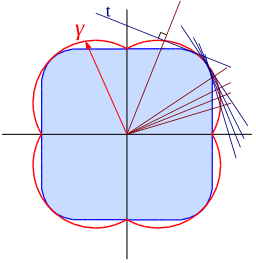
Wulff construction
A Wulff plot (the surface energies are given in red)
Drawing by Michael Schmid
and used under the GNU Free Documentation License 
I first ran into the name Wulff last year in my thermodynamics class. He gave his name to a method for constructing the shape that a single crystal will take based on the surface energies of different crystallographic directions. It is a clever construction, and that particular homework problem was probably my favorite of the whole year. So I decided to see what I could find out about Wulff, and I have found him very difficult to track down, so I put this post on the shelf. Then in winter quarter I ran into the name again in an x-ray diffraction class where we used Wulff nets, and I decided to track him down again. It proved no easier, but I did get farther! It does seem strange, though, for a man who's name is so often used, that there is so little information on him. He doesn't even have an English Wikipedia page! The first reason for confusion about Wulff is that he was Ukrainian, so there are different transliterations of his name, but worse than that, he went by two names! Georg Wulff was the name he used in German-language publications, and thus is the name that we are more familiar with, but his name in Russian (transliterated, of course) was Yuri Viktorovich. I did, at last, find a nice article on him in the Complete Dictionary of Scientific Biography, and some information in one of my x-ray diffraction textbooks.

Image of a projection from Wulff's 1902 paper
Georg Wulff was born in the Ukraine in 1863 and studied at Warsaw University. In 1907, or 1908, or 1911, he became a professor (or teacher) of crystallography at Moscow University. Nobody seems to be able to agree. What is important, I think, is that between defending his dissertation and his death, he taught in various capacities at universities in Russia and the U.S.S.R.

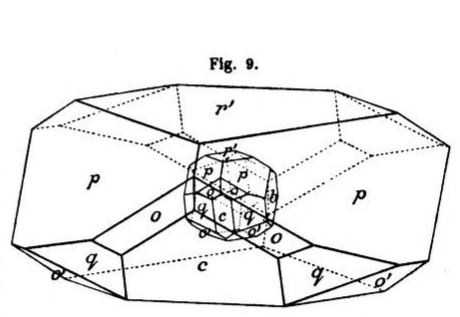
He published two important papers in 1901 and 1902 regarding crystal structures and stereographic projections. They are both in German, so I don't know exactly what they are getting at. Hammond says that Wulff proposed the Wulff net in 1909, but there seems to be an image of part of a Wulff net in his 1902 paper. His 1901 paper introduced the principles of the Wulff construction, which is a graphical method for determining the faces of a crystal that are expressed based on the surface energy of the different crystallographic directions. This idea built on Josiah Gibbs' proposal that materials want to minimize total surface energy. Wulff himself did not prove mathematically why his construction worked, but it was proved by Conyers Herring (1914-2009) in the 1950s.
Crystal diagram from Wulff's 1901 paper

Wulff was also in communication with William Henry Bragg and his son, William Lawrence Bragg, English crystallographers. Wulff derived an equation for x-ray diffraction in 1913 that was equivalent to the one proposed the year before by the Braggs, and so some people at the time called what is now known as Braggs' Law the Bragg-Wulff Law. Wulff appears to have lost out on the name because he published second, and, more importantly, he did not follow up with as many advancements on the topic as the Braggs. After that, he appears not to have taken on any new areas of study and faded into obscurity, though not without leaving his name for students of thermodynamics and crystallography to stumble upon.


Works


References

Saturday, April 27, 2013

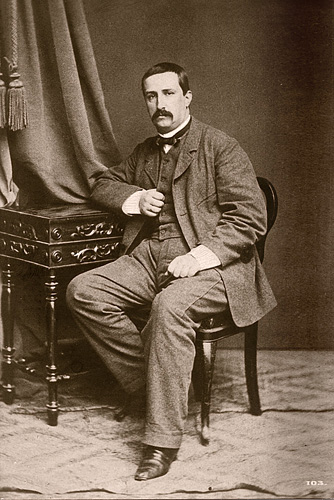
Alexander Borodin: Chemist Composer

Alexander Borodin (1833-1887)
The topic of this post is at the suggestion of Melissa. Thanks for commenting! I enjoyed researching Borodin.

Alexander Borodin was a Russian composer and chemist. Those two seem to be very divergent, and in reading about him, it is interesting that I can find very little about if the two fields interacted in any practical way. In fact, his science appears to have gotten in the way of his composing. I had never heard of him, or at least thought I hadn't. It turns out I have heard some of his music. Here is an example, the Polovtsian Dances from the opera Prince Igor. I would suggest starting this and listening while continuing to read, though the ballet is quite good too.


Borodin was the illegitimate son of a Georgian prince, but he was born in Saint Petersburg and registered as the son of a serf. The prince did not forget him, though, and he was able to receive a good education. He was interested in both science and music, and wrote his first existing composition, a polka, at the age of 9. He attended the Medico-Surgical Military Academy in Saint Petersburg and started out as a doctor, though he became very interested in chemistry and studied with the chemist Nikolay Zinin, who apparently was a Russian chemist of note. Despite being at a medical school, Borodin was squeamish and therefore not well suited to being a doctor, so he continued his chemistry studies. Zinin is said (probably apocryphally) to have told him
Mr. Borodin, it would be better if you gave less thought to writing songs. I have placed all my hopes in you, and want you to be my successor one day. You waste too much time thinking about music. A man cannot serve two masters." (Podlech, from another source)
 Borodin did not give up "writing songs", but still managed to become Zinin's successor. After graduating in 1858, he traveled Europe for three years. He started in Heidelberg, working first with Robert Bunsen, though he ended up staying longer with Emil Erlenmeyer (and I've already written about them!). There he became friends with Dmitri Mendeleev (of the periodic table) and his future wife, the pianist Yekaterina Protopopova. He also attended the Karlsruhe Congress in 1860, an important milestone in understanding and standardizing atomic weights. He went with Yekaterina to Pisa and asked to work in the laboratory of de Luca and Tassinari (whom I had never heard of ). They had platinum retorts, which enabled him to work with corrosive substances. There he was able to make the first nucleophilic replacement of a halogen with fluorine, which was difficult because of the strength of fluorine bonds and fluorine's toxicity.

http://a2.ec-images.myspacecdn.com/images02/124/2fe162eddc9e4dd18038c7c64500805d/l.jpg
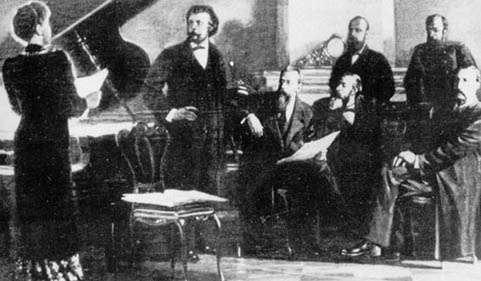
The Five. From left to right: singer, Mussorgsky,
Rimsky-Korsakov, Vladimir Stasov, Balakirev, Cui, and Borodin
Upon his return to Saint Petersburg, he became a professor, and also a member of The Five. The Five was a group of Russian composers in Saint Petersburg who were self-trained amateurs but wanted to write music that was authentically Russian. The other composers in this group were Modest Mussorgsky, Nikolai Rimsky-Korsakov, Mily Balakirev, and César Cui. Not a shabby bunch to be hanging out with!

Borodin continued his research and composing. One of the interesting things that happened in the next decade was a sort of dispute with August Kekulé. Borodin had been studying aldehydes, but Kekulé began research into their condensation in the late 1860s. It seems rather confusing who did what, but Borodin seemed to think that Kekulé was impinging on his territory. However, Borodin wasn't publishing much, so it was hard to actually make a claim. Eventually, Borodin ceded and returned to his work on amides. One of his most significant contributions in this field was a simple device to measure the amount of urea in animal urine. I have no idea why people wanted to use that, but contemporaries seemed pretty excited. After 1875, he did not publish any full papers. Instead, he spent more time on training students and advocating for women's rights. He gave lectures and provided special instruction for the female students studying medicine.

One wonders how Borodin juggled composing with science, and I found a great quote that expresses his difficulties.
In winter I can only write music when I am so ill that I don't give lectures, don't go to the laboratory, yet all the same can work a little. For this reason my musical friends, contrary to universal custom, always wish me not health, but sickness. (Letter to Liubov' Ivanova Karmalina, June 1, 1876)
Though his total oeuvre is small, the quality of his work is generally acknowledged to be good. He wrote two symphonies, some chamber music compositions, songs, and much of an opera. He worked on Prince Igor from 1869 until his death in 1887. Rimsky-Korsakov was concerned about it getting finished, and offered to help with it as much as he could. In the end, though, Rimsky-Korsakov and Alexander Glazunov had to finish it after Borodin's death, which unfortunately occurred at a fancy dress party.


References

Friday, November 23, 2012

The Bunsen Burner, Spectroscopy, and Geysers

Robert Bunsen (1811-1899)
Robert Bunsen deserves to be remembered for more than his "invention" of the Bunsen burner.  He was a brilliant chemist, and did work in spectroscopy, blast furnaces, batteries, and even geology.  One of the things that I like about writing this blog is seeing just how many pies these scientists managed to get their fingers in. They were curious, and made discoveries that, even if tangential to their regular work, are in many cases still remembered.  See my last post on Bohr for one example.  Probably Bunsen's most notable research out of the field of chemistry was his foray into geysers.  In the 1840s, on a trip to Iceland to study the recently erupted volcano Mount Hekla.  But he also became curious about the geyser there and did some measurements.  He came up with a theory about how geysers work, and did a demonstration with a model geyser to show that his theory worked.  That would have been a fun demonstration to see!

His early research was in organic chemistry, and he studied arsenic compounds and arsenic poisoning. He showed that iron oxide hydrate could be used as an antidote for arsenic poisoning, and also did extensive research into cacodyl compounds.  While still a young chemist, he nearly died of arsenic poisoning and lost the use of one eye from an explosion of one of his arsenic-containing compounds.  I have not found anyone to say why he discontinued his studies of cacodyl compounds, but I think it may have had to do with their obviously dangerous effects.  The results of his work helped Edward Frankland and Friedrich Kekulé in their studies of chemical valency. Bunsen also studied blast furnaces, which were of great importance in the 1830s due to the huge amounts of iron being produced.  He showed that over half of the fuel was lost, and worked with Lyon Playfair to improve the furnaces to be more efficient and to catch potentially useful byproducts.  This work resulted in his only book, Gasometry: Comprising the Leading Physical and Chemical Properties of Gases.

When Robert Bunsen became a professor at the University of Heidelberg in 1852, he took charge of a new laboratory building.  The building was equipped with gas, and during construction, Bunsen made suggestions to the building's mechanic, Peter Desaga, regarding the burners to be used.  There had been previous burners used, including one by Michael Faraday, but his was an improvement on these and enabled the flame to be hot, sootless, and non-luminous.  A biographer wrote at his death that "The Bunsen burner is now in use everywhere from the kitchen to the research laboratory." (Crew, p. 302) Not sure how it was used in the kitchen, but there you have it.

Bunsen and Kirchhoff's spectrometer
Though I could also write about his carbon-zinc battery that was much cheaper to make and longer lasting than the previous platinum covered plates, or his invention of the ice-calorimeter and the vapor calorimeter, I do want to talk about his spectroscopic work, which is perhaps most important, and led to the discovery of two new elements.  Bunsen's work with spectroscopy was done in collaboration with Gustav Kirchhoff (Kirchhoff's Law, anyone?), whom he met in 1851.  He had already been interested in light, such as the improvement of the gas burner and showing that an electric current could create light.  Kirchhoff joined Bunsen at Heidelberg and they formed, so it seems, a great team.  Bunsen's work with electrochemistry and batteries gave him the ability to separate metals, and the non-luminous burner that he had improved meant that he could use flame tests to see the different colors that metals gave off.  Kirchhoff suggested that the colors of different metals that had similar colors might be able to be distinguished by looking at the spectra with a prism.  They found that these spectra were unique to different elements.  When they noted a new spectral blue line, Bunsen hypothesized that it was a new element and went on to distill 40 tonnes of water to isolate 50 grams of a chloro-platinic coumpound, from which he identified this new element, which he called cesium, Latin for deep blue, from the blue line in its spectrum.  In 1861 he announced the discovery of rubidium, and thereafter others used his spectroscopic methods to discover and isolate thallium, indium, germanium, gallium, and scandium.

If you are not familiar with the principle of a flame test, or even if you are because it is always cool, the following video is a nice demonstration of the different colors that different metals are, and shows the spectral lines too.


I will conclude with a sad reminder to back up your data. Bunsen also studied the spectra of rare earth metals, and had just finished a large manuscript on the subject.  He left the manuscript on a table near a glass of water, and when he came back, he found the manuscript burnt.  It took him two years to replicate the data and apparatuses.  So the equivalent of hard drive crashes are nothing new.


Works by Bunsen
References


Wednesday, October 3, 2012

Bohr's Dueling Discovery

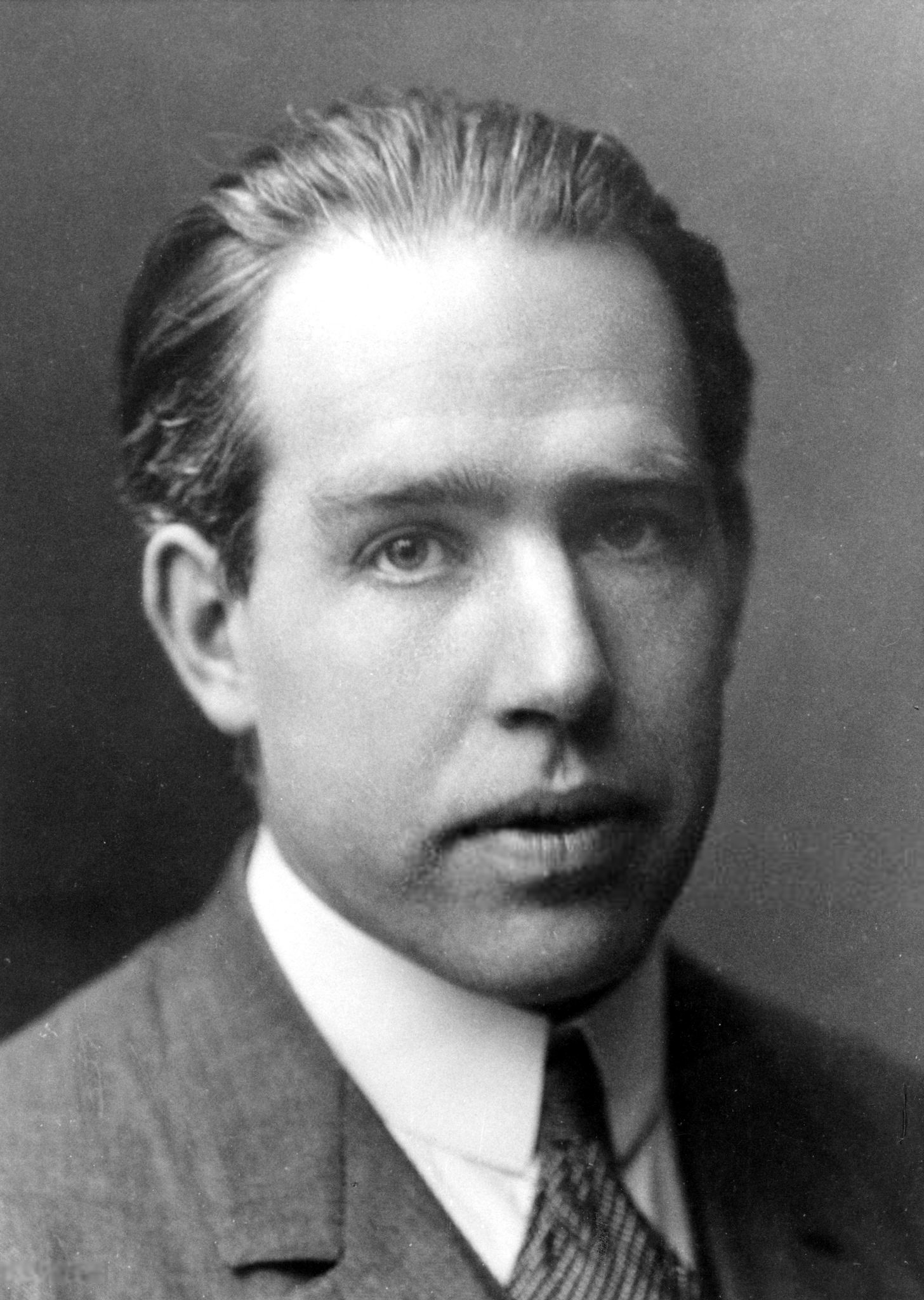
Niels Bohr (1885-1962)
Unfortunately this summer I wasn't able to finish as many posts as I had hoped, so rather than a full post today, here is a tidbit.  As per the latest poll, up this week is Niels Bohr! But there is a lot to talk about, particularly with respect to the atom, so instead, I'll talk about something you probably didn't know. One of Niels Bohr's contribution to science derived from his love of western films. He noted that the bad guys always drew first, but the good guys always won, and wondered if it was actually the case that the person who drew second won more often. He went out and purchased some cap guns and "dueled" his friends to find out. Sure enough, always drawing second, he won. Recently, proving that Bohr didn't just have faster reflexes than his friends, Andrew Welchman at the University of Birmingham confirmed that the second person to draw is milliseconds faster to the trigger. So stick to your hobbies!  You never know where they may lead.

References

Friday, August 10, 2012

John Dalton: Atoms, Weather, and Vision

John Dalton
1766-1844
Since one of my undergraduate degrees was in chemistry, I cannot believe that to this point I have only written one post that warranted the tag of "chemists." So this post is an attempt to remedy this. In looking at the lists of names that I have as potential subjects for blog posts, the first that jumped out at me were Henderson and Hasselbalch, famous for the equation for determining the pH of a buffer solution.  But I try to mix up the time periods that I write about, which either means that you, my readers, do not get bored or that you get horribly confused.  If it is the latter, I apologize.  I would have guessed that the Henderson-Hasselbalch equation was developed in the nineteenth century, but it ws actually in the 20th century, which eliminates them from consideration at the present time.  So instead, I have decided to write on John Dalton, of Dalton's Law of Partial Pressures, which you may (or may not) remember from high school chemistry. Dalton is also well known for his work in developing modern atomic theory.  Whether or not you know much about either of these topics, it is easy enough to find information on his contributions in these areas.  So I would like to focus in this post on two areas that receive less attention, his meteorological observations and studies on color blindness.

Dalton's System of Chemical Philosophy
Dalton's atomic and
molecular symbolism, from
A New System of Chemical Philosophy
Dalton’s interest in meteorology began while he was at school in Kendal, where he made the acquaintance of John Gough, who was nine years his senior.  It was he who first suggested that Dalton keep a meteorological journal.  Dalton made observations throughout his long life, including a measurement made the day before his death.  His first book of observations, Meteorological Observations and Essays, was published in 1793, with a second edition little changed from the first appearing in 1834.  While some of the book is simply his observations, he also included descriptions of many of the techniques used in making observations of the weather in use at the time.  He noted in the preface that “as the number of [barometers and thermometers] is increasing daily, many of them must fall into hands that are much unacquainted with their principles.”  In addition to writing about barometers, thermometers, hygrometers, thunderstorms, snows, winds, and the Aurorae Boreales, he also included essays regarding these phenomenon, particularly Aurora Borealis and its connection with magnetism.  It was his study of the atmosphere, a gas, that probably led to his interest in gases in general, which finally led him to his theories of atomic structure.  He also attempted to come up with the structures of many molecules, but was not always right since he didn’t know how much each atom actually weighed.  For instance, he thought that water was HO (one hydrogen atom and one oxygen atom) rather than H2O.

John Dalton also put much thought into color blindness, a condition that he suffered from. He gave a lecture at the Manchester Literary and Philosophical Society, of which he was a member, in 1794, describing the inconsistencies that he observed between how he saw color and how those around him saw colors.  He wrote to a friend that “the flowers of most of the Cranesbills appear to me in the day almost exactly sky blue, whilst others call them deep pink.” (The Worthies of Cumberland: John Dalton, p. 101) He also noted that his brother and he agreed on the colors of things, which to modern ears suggests that it was genetic color blindness.  Dalton suggested that the cause of the difference between  his vision and others was that the fluid in his eye was tinted blue.  As a true scientist, he suggested that his eyes should be dissected after his death to see if this was true.  It was not, but the eyes were preserved by the Manchester Literary and Philosophical Society and recently the DNA was examined, showing that Dalton lacked one of the three photopigments in the eye.  (If you wish to see the present state of his eyes and related images, I suggest you go to http://www.sciencephoto.com/set/803.) This theory of photopigments had been proposed by Thomas Young (1773-1829), one of Dalton’s contemporaries who established the wave theory of light, but even though Young’s view was more correct, color blindness has been historically called Daltonism. This just goes to show that you don’t have to be right to be remembered, you just have to be the first, or perhaps the clearest.


Selected Works by Dalton
References and further reading

Sunday, July 15, 2012

Hans Geiger and the Geiger-Müller Counter

Hans Geiger (1882 - 1945)
The first SciHistory poll is responsible for the subject of this latest post, Hans Geiger.  I will try to always have a poll open, so when you stop by, vote!  And remember that you can always leave suggestion in the comments, even if it isn't at all relevant to the subject of the post.  But on to more serious business. (And I do apologize.  In rereading this post, it is kind of dull.)

Hans Geiger was born in Germany and received his PhD from the University of Erlangen in 1906.  After graduating, he went to England to work at the University of Manchester with Ernest Rutherford (1871-1937), who won the 1908 Nobel Prize in physics for his work with radioactive substances.  One of the first projects that Geiger collaborated on in Rutherford's lab was the famous gold foil experiment, also called the Geiger-Marsden experiment (Marsden was an undergrad working with Geiger) or the Rutherford experiment.  In this experiment, where helium nuclei (alpha particles) were fired at a thin sheet of gold, Rutherford hoped to better understand the actual composition of atoms.  When some of the particles deflected at very high angles, a reasonable explanation was that rather than having the mass of an atom spread fairly evenly, there must be a highly concentrated nucleus to an atom.  This experiment was vital to the modern understanding of the structure of the atom.

Geiger continued to work with alpha-particles, developing the first detector for alpha particles in 1908.  This consisted of a wire in a low pressure chamber with a voltage applied across the wire and the outside of the tube.  The voltage is high enough that a current can almost, but not quite, flow through the gas. When an ionizing particle came into contact with the wire, it disturbs the system enough to complete the circuit, and the resulting completion can be detected by an audible click or by a pointer, depending on the type of counter. Design variables included the applied voltage, the pressure inside the chamber, and the length and diameter of the tube. Geiger continued to try to make more sensitive devices, and in 1913, after returning to Berlin to work at the German National Institute for Science and Technology, created a more sensitive device that used a needle that stuck into the middle of the detecting tube, rather than a wire connected at both ends.  This version was able to detect both alpha and beta particles.

Geiger served as an artillery officer during World War I, and when he returned to direct radiation research at the University of Kiel and the University of Tübingen, and later at Technische Hochschule in Berlin. It was while working with a post-doc, Walther Müller, at Kiel, that the next breakthrough in the Geiger counter occurred.  Geiger wanted Müller to determine the precise effect of a positive ion on the counter, and in general to test different configurations, voltages, polarities, etc.  It was as a result of this that Müller discovered a configuration that lead to an increase in sensitivity of about 100 times, which is why in many publications and discussions of Geiger counters, one finds them called Geiger-Müller counters.  The increased sensitivity of this counter made them more useful for the detection of cosmic rays, which were a subject of much interest around that time.  They could also be combined with cloud chambers to watch electrons moving individually.

After this discovery, the sources that I have found don't talk about what Geiger did next much.  He continued researching radiation in various forms, including cosmic rays and nuclear fission.  He was involved in the German efforts to create a nuclear bomb, and died a few months after World War II ended.  What I find most interesting about his story is that he, more than many of the other people that I have written about so far, worked in collaborations.  The gold-foil experiment was done with Marsden, but the conclusions about the atom were Rutherford's.  The improved Geiger counter was the work of a student.  I think this way of doing research is much more what we are familiar with today, when papers can have ten co-authors and, especially as a graduate student, one's advisor's name is on everything.  Clearly, Geiger made important contributions, but he was not working alone.


Works by Geiger
References and Further Reading
  • "Hans Geiger". Encyclopædia Britannica Online. Encyclopædia Britannica Inc., 2012. Accessed July 13, 2012.
  • Thaddeus Trenn, "The Geiger-Müller Counter of 1928", Annals of Science 43, 2 (1986), 111-135.
  • "Geiger Counter", Lemelson-MIT Inventor of the Week, February 2005.
  • M. Walter and A. W. Wolfendale, "Early history of cosmic particle physics", The European Physical Journal H (2012). doi:  10.1140/epjh/e2012-30020-1
  • Paul Frame, "A history of radiation detection instrumentation", Health Physics 88, 6 (2005), 613-637.