Showing posts with label Chemists. Show all posts

Friday, October 23, 2015

Avogadro's Number Part 1: A History of the Mole with Very Little about Avogadro

Happy Mole Day! I thought that it would be appropriate to recognize the day with a post about Avogadro's Number and the associated Mole.  Avogadro's Number, which denotes the number of objects in a mole (6.022*1023), has a certain fascination for people, particularly, in my experience, among chemistry students.  There is even a website (and foundation) dedicated to Mole Day and the mole. While I have been trying to make these posts about people, to get to the bottom of Avogadro's number, one has to dig a lot deeper than Avogadro.  He does, however, make a good starting place.

Amedeo Avogadro (1776-1856)
Lorenzo Romano Amedeo Carlo Avogadro of Quaregna and Cerreto (phew, that's long) was by training a lawyer. He became interested in math and physics around 1800 and started working with electricity and metallic salts. Despite his lack of formal training, he did end up with a post as the chair of theoretical physics at the University of Turin. One of his projects was determining the electronegativity of various elements. He is best known for, and has the mole name after him because of, his "molecular hypothesis", first suggested in an essay in 1811. He suggested that molecules in a gas are scattered such that the average distance is constant when the temperature and pressure are constant. That is, that at the same temperature and pressure, there are the same number of molecules in a set volume of one gas as of another gas. By using this hypothesis, he was able to calculate the molecular weight of gases by using their densities.This, however, put Avogadro in opposition to John Dalton (1766-1844), who had rejected this idea (see page 555 onwards of A New System of Chemistry, 1810). This was in part because Dalton and others believed that all gases contained only one atom of an element--for instance, that a molecule of water was HO rather than H2O. Since Avogadro kept to himself and tended to cite himself, his hypothesis did not gain much credibility, though André-Marie Ampère (1775-1836) came to the same conclusion in 1814. This additional support doesn't seem to have helped any, so it was a while before his hypothesis was accepted.

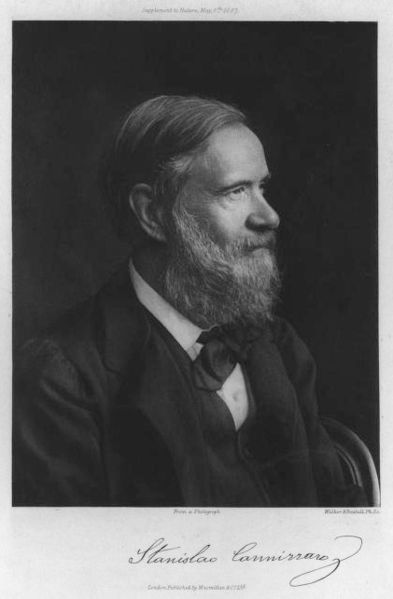
Stanislao Cannizzaro (1826-1910)
By the middle of the 19th century, scientists were still debating about the nature of atoms, molecules, and their divisibility, and to make matters worse, they were starting to write formulas, diagrams, and calculate masses without a standard system. They could not agree on notations and other conventions, such as how to write chemical formulas or what the standard weight for describing an atom would be. In order to deal with these problems, August Kekulé (1829-1896) organized what came to be known as the Karlsruhe Congress, which met in September 1860 in Karlsruhe, Germany. The hero of the day was Stanislao Cannizzaro, who had written an article in 1858 that was based on Avogadro's hypothesis. This paper was circulated at the conference, and in it Cannizzaro suggested that the weight of hydrogen be taken as 1.0. He also suggested that oxygen be assumed to be diatomic as a gas, such that the formula for water would be H2O and the mass is 16.0. Cannizzaro clearly stated a theory in which atoms, molecules, and multiple identical atoms in the same molecule are distinguished. His argument and explanation influenced Lothar Meyer and Dimitri Mendeleev to both accept Avogadro's hypothesis, and after the conference it gained a wider popularity.

Few scientists, however, were concerned with how many molecules were actually in that volume of gas. They were more concerned with the hypothesis itself and what that meant for being able to determine other properties of matter, such as how big atoms and molecules actually are. The next step in determining Avogadro's number takes us from Avogadro and Cannizzaro in Italy to Austria, where Johann Josef Loschmidt (1821-1895) was working.
https://commons.wikimedia.org/wiki/File:Johann_Josef_Loschmidt.jpg
Johann Josef Loschmidt (1821-1895)
(image from Wikimedia commons)

Loschmidt wanted to find out what the actual size of a molecule of a gas was, and used current theories of gases to determine this. Rudolph Clausius had derived in 1859 the mean free path of molecules in a gas in terms of the cross-sectional area, and James Maxwell derived his own expression the following year. Loschmidt then calculated what fraction of the gas was occupied by the molecules themselves based on the mean free path and then assumed that when the gas is liquefied, the volume is only slightly larger than that of the molecules themselves. The problem then was the air had not been liquefied, so he used the work of Hermann Kopp to estimate the density of liquid air. He determined that the size of a nitrogen molecule was 9.69*10-10 m, or about three times too big. But not bad. However, despite knowing how big molecules were, no one seemed particularly concerned about how many molecules were in a region of space. A following paper in 1865, ostensibly by Loschmidt, states that a cubic millimeter of gas contains 866 billion molecules, but that wasn't the point of the article.

Studies of gasses over the course of the rest of the century and into the 20th century would help to elucidate the question of how many molecules are in a given volume, but I will leave that for another day! Check back soon (or subscribe to the emails) for more information about the definition and calculation of Avogadro's number and where the name mole came from.


Original Papers in order of publication
References

Saturday, August 23, 2014

Wilhelm Ostwald

Wilhelm Ostwald (1853-1932)
 Licensed under Public domain
 via Wikimedia Commons
One of my favorite things about writing this blog is discovering the interesting interests that the scientists
that I write about had, in addition to whatever work they are remembered for. So as I started to look for information on Wilhelm Ostwald, I was fascinated to discover that there were articles discussing his involvement with color and the Bauhaus (an art school in Germany in the 20s). Ostwald ripening, which is where I had heard his name before, seems to be one of the more minor contributions that he made: Ostwald won the 1909 Nobel Prize in Chemistry primarily for his work with catalysis, wrote 45 books and about 1000 publications, and is considered one of the founders of physical chemistry.

Ostwald was born in 1853 in Riga, Russia, and became a professor at Riga Polytechnic in 1882. One of his duties was to expand the laboratory, so he toured laboratories in Germany and had the opportunity to meet many German scientists. One of the things that he did at Riga was writing a two volume textbook. Another was translating Gibb’s work on chemical thermodynamics into German, which enabled it to be more widely read in Europe than the original English. He founded, with van’t Hoff, the first journal in physical chemistry,  Zeitschrift für Physikalische Chemie. It wasn’t the first journal he founded—he later started Annalen der Naturphilosophie.

In 1887 he then moved on to a position in Leipzig as the chair of physical chemistry—the only chair in physical chemistry in Germany. That same year he first recognized that catalysis was a kinetic process when he was studying the oxidation of hydrogen iodide by bromic acid, leading to the idea that a catalyst is something that modifies the rate of a reaction without being changed its self. Later, he tried to apply this to the problem of nitrogen fixation, but his method by catalysis with iron did not work. He did, however, patent a process for making nitric acid out of ammonia using a platinum catalyst in 1902, which is still the most commonly used process for making nitric acid today.

Svante Arrhenius published a paper in 1887 on electrolytic dissociation, the first in the field of electrochemistry. Ostwald had studied salt decomposition in obtaining a degree, and returned to it, developing his dilution law. He also wrote Elektrochemie from 1893-1896, a text on the subject, in which he also included the history of the developments and biographies of the scientists involved. He also formed an electrochemical society in 1894.

After about 1900, Ostwald turned more of his attentions to ideas of natural philosophy. In one of his works, Grosse Männer,  he divided scientists into two categories, classicists or romantics. There is actually a very interesting article by Robert Deltete and David Thorsell that compares the working styles of Josiah Gibbs and Wilhelm Ostwald as examples of these two styles. Ostwald is the romantic, jumping from one idea to the next, making connections with many people and not being afraid of publishing work before it is finished. Gibbs, on the other hand, led a fairly reclusive life, taught few students, and did not publish his work on thermodynamics until it was completed to his satisfaction.

Ostwald retired in 1906, but continued being involved in many different projects, societies, and researches. One of these was Brücke (The Bridge), an organization with the goal of organizing science to make it more efficient. Ostwald had been interested in energy for quite some time, and was actually one of the last well-renowned scientists to reject atomism. He favored an energetic explanation, and as such, conserving energy in many forms was one of his interests. He even named his retirement home, which he moved to in 1906, Haus Energie.[1] Some of the things that the Bridge did were to promote Esperanto as a universal language for science, reducing the need for translations of works, and to standardize publication formats for scientific publications. Several other scientists of note were involved in the Bridge, including Svante Arrhenius, Ernest Solvay, Ernest Rutherford, and Henri Poincaré. Ostwald also became involved in the German Monistic Alliance, which also had as its aim the unification of science, but included the reorganization of society as well. Ostwald was involved in both until Brücke closed in 1914 due to lack of funding and the difficulties of unifying science during the Great War.

After World War I, Ostwald he turned his attentions to color theory. He had been a painter since at least 1884, and now turned his scientific energies to color and developing a color theory. One of his most important contributions was giving value to the color grey. He even opened a pigment factory from 1920-1923. Walter Gropius invited him to speak at the Bauhaus and he even became a trustee. Ostwald considered his contributions to color theory some of his greatest work and nominated himself for a Nobel Prize for it (while, having won a Nobel Prize, he could nominate people, one can’t nominate ones self).

Now I don’t know how many of you may be materials scientists or others interested in Ostwald ripening, but I realize I haven’t mentioned it since the first paragraph. It is because very few of the articles I read even mentioned that work, and for a little while I was convinced that I had gotten the wrong Ostwald. But it turns out that this is the right guy. Ostwald ripening, which is a thermodynamic process observed in solutions, either solid or liquid, where larger crystals grow and smaller crystals shrink, comes from his work in the late 1890s.

[1] The house has been preserved, and was recently purchased by Gerda und Klaus Tschira Stiftung and it will serve as a location for scientific meetings. (Ertl, 2009)


Selected Works by Ostwald
References

Saturday, April 27, 2013

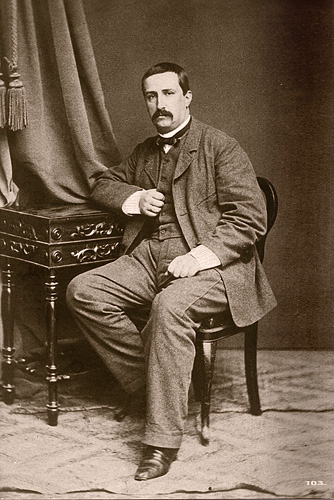
Alexander Borodin: Chemist Composer

Alexander Borodin (1833-1887)
The topic of this post is at the suggestion of Melissa. Thanks for commenting! I enjoyed researching Borodin.

Alexander Borodin was a Russian composer and chemist. Those two seem to be very divergent, and in reading about him, it is interesting that I can find very little about if the two fields interacted in any practical way. In fact, his science appears to have gotten in the way of his composing. I had never heard of him, or at least thought I hadn't. It turns out I have heard some of his music. Here is an example, the Polovtsian Dances from the opera Prince Igor. I would suggest starting this and listening while continuing to read, though the ballet is quite good too.


Borodin was the illegitimate son of a Georgian prince, but he was born in Saint Petersburg and registered as the son of a serf. The prince did not forget him, though, and he was able to receive a good education. He was interested in both science and music, and wrote his first existing composition, a polka, at the age of 9. He attended the Medico-Surgical Military Academy in Saint Petersburg and started out as a doctor, though he became very interested in chemistry and studied with the chemist Nikolay Zinin, who apparently was a Russian chemist of note. Despite being at a medical school, Borodin was squeamish and therefore not well suited to being a doctor, so he continued his chemistry studies. Zinin is said (probably apocryphally) to have told him
Mr. Borodin, it would be better if you gave less thought to writing songs. I have placed all my hopes in you, and want you to be my successor one day. You waste too much time thinking about music. A man cannot serve two masters." (Podlech, from another source)
 Borodin did not give up "writing songs", but still managed to become Zinin's successor. After graduating in 1858, he traveled Europe for three years. He started in Heidelberg, working first with Robert Bunsen, though he ended up staying longer with Emil Erlenmeyer (and I've already written about them!). There he became friends with Dmitri Mendeleev (of the periodic table) and his future wife, the pianist Yekaterina Protopopova. He also attended the Karlsruhe Congress in 1860, an important milestone in understanding and standardizing atomic weights. He went with Yekaterina to Pisa and asked to work in the laboratory of de Luca and Tassinari (whom I had never heard of ). They had platinum retorts, which enabled him to work with corrosive substances. There he was able to make the first nucleophilic replacement of a halogen with fluorine, which was difficult because of the strength of fluorine bonds and fluorine's toxicity.

http://a2.ec-images.myspacecdn.com/images02/124/2fe162eddc9e4dd18038c7c64500805d/l.jpg
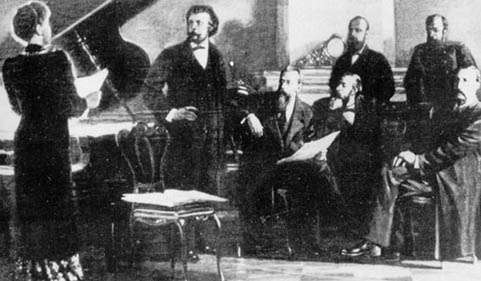
The Five. From left to right: singer, Mussorgsky,
Rimsky-Korsakov, Vladimir Stasov, Balakirev, Cui, and Borodin
Upon his return to Saint Petersburg, he became a professor, and also a member of The Five. The Five was a group of Russian composers in Saint Petersburg who were self-trained amateurs but wanted to write music that was authentically Russian. The other composers in this group were Modest Mussorgsky, Nikolai Rimsky-Korsakov, Mily Balakirev, and César Cui. Not a shabby bunch to be hanging out with!

Borodin continued his research and composing. One of the interesting things that happened in the next decade was a sort of dispute with August Kekulé. Borodin had been studying aldehydes, but Kekulé began research into their condensation in the late 1860s. It seems rather confusing who did what, but Borodin seemed to think that Kekulé was impinging on his territory. However, Borodin wasn't publishing much, so it was hard to actually make a claim. Eventually, Borodin ceded and returned to his work on amides. One of his most significant contributions in this field was a simple device to measure the amount of urea in animal urine. I have no idea why people wanted to use that, but contemporaries seemed pretty excited. After 1875, he did not publish any full papers. Instead, he spent more time on training students and advocating for women's rights. He gave lectures and provided special instruction for the female students studying medicine.

One wonders how Borodin juggled composing with science, and I found a great quote that expresses his difficulties.
In winter I can only write music when I am so ill that I don't give lectures, don't go to the laboratory, yet all the same can work a little. For this reason my musical friends, contrary to universal custom, always wish me not health, but sickness. (Letter to Liubov' Ivanova Karmalina, June 1, 1876)
Though his total oeuvre is small, the quality of his work is generally acknowledged to be good. He wrote two symphonies, some chamber music compositions, songs, and much of an opera. He worked on Prince Igor from 1869 until his death in 1887. Rimsky-Korsakov was concerned about it getting finished, and offered to help with it as much as he could. In the end, though, Rimsky-Korsakov and Alexander Glazunov had to finish it after Borodin's death, which unfortunately occurred at a fancy dress party.


References

Friday, November 23, 2012

The Bunsen Burner, Spectroscopy, and Geysers

Robert Bunsen (1811-1899)
Robert Bunsen deserves to be remembered for more than his "invention" of the Bunsen burner.  He was a brilliant chemist, and did work in spectroscopy, blast furnaces, batteries, and even geology.  One of the things that I like about writing this blog is seeing just how many pies these scientists managed to get their fingers in. They were curious, and made discoveries that, even if tangential to their regular work, are in many cases still remembered.  See my last post on Bohr for one example.  Probably Bunsen's most notable research out of the field of chemistry was his foray into geysers.  In the 1840s, on a trip to Iceland to study the recently erupted volcano Mount Hekla.  But he also became curious about the geyser there and did some measurements.  He came up with a theory about how geysers work, and did a demonstration with a model geyser to show that his theory worked.  That would have been a fun demonstration to see!

His early research was in organic chemistry, and he studied arsenic compounds and arsenic poisoning. He showed that iron oxide hydrate could be used as an antidote for arsenic poisoning, and also did extensive research into cacodyl compounds.  While still a young chemist, he nearly died of arsenic poisoning and lost the use of one eye from an explosion of one of his arsenic-containing compounds.  I have not found anyone to say why he discontinued his studies of cacodyl compounds, but I think it may have had to do with their obviously dangerous effects.  The results of his work helped Edward Frankland and Friedrich Kekulé in their studies of chemical valency. Bunsen also studied blast furnaces, which were of great importance in the 1830s due to the huge amounts of iron being produced.  He showed that over half of the fuel was lost, and worked with Lyon Playfair to improve the furnaces to be more efficient and to catch potentially useful byproducts.  This work resulted in his only book, Gasometry: Comprising the Leading Physical and Chemical Properties of Gases.

When Robert Bunsen became a professor at the University of Heidelberg in 1852, he took charge of a new laboratory building.  The building was equipped with gas, and during construction, Bunsen made suggestions to the building's mechanic, Peter Desaga, regarding the burners to be used.  There had been previous burners used, including one by Michael Faraday, but his was an improvement on these and enabled the flame to be hot, sootless, and non-luminous.  A biographer wrote at his death that "The Bunsen burner is now in use everywhere from the kitchen to the research laboratory." (Crew, p. 302) Not sure how it was used in the kitchen, but there you have it.

Bunsen and Kirchhoff's spectrometer
Though I could also write about his carbon-zinc battery that was much cheaper to make and longer lasting than the previous platinum covered plates, or his invention of the ice-calorimeter and the vapor calorimeter, I do want to talk about his spectroscopic work, which is perhaps most important, and led to the discovery of two new elements.  Bunsen's work with spectroscopy was done in collaboration with Gustav Kirchhoff (Kirchhoff's Law, anyone?), whom he met in 1851.  He had already been interested in light, such as the improvement of the gas burner and showing that an electric current could create light.  Kirchhoff joined Bunsen at Heidelberg and they formed, so it seems, a great team.  Bunsen's work with electrochemistry and batteries gave him the ability to separate metals, and the non-luminous burner that he had improved meant that he could use flame tests to see the different colors that metals gave off.  Kirchhoff suggested that the colors of different metals that had similar colors might be able to be distinguished by looking at the spectra with a prism.  They found that these spectra were unique to different elements.  When they noted a new spectral blue line, Bunsen hypothesized that it was a new element and went on to distill 40 tonnes of water to isolate 50 grams of a chloro-platinic coumpound, from which he identified this new element, which he called cesium, Latin for deep blue, from the blue line in its spectrum.  In 1861 he announced the discovery of rubidium, and thereafter others used his spectroscopic methods to discover and isolate thallium, indium, germanium, gallium, and scandium.

If you are not familiar with the principle of a flame test, or even if you are because it is always cool, the following video is a nice demonstration of the different colors that different metals are, and shows the spectral lines too.


I will conclude with a sad reminder to back up your data. Bunsen also studied the spectra of rare earth metals, and had just finished a large manuscript on the subject.  He left the manuscript on a table near a glass of water, and when he came back, he found the manuscript burnt.  It took him two years to replicate the data and apparatuses.  So the equivalent of hard drive crashes are nothing new.


Works by Bunsen
References


Friday, August 10, 2012

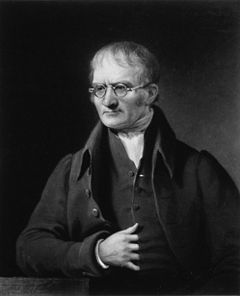
John Dalton: Atoms, Weather, and Vision

John Dalton
1766-1844
Since one of my undergraduate degrees was in chemistry, I cannot believe that to this point I have only written one post that warranted the tag of "chemists." So this post is an attempt to remedy this. In looking at the lists of names that I have as potential subjects for blog posts, the first that jumped out at me were Henderson and Hasselbalch, famous for the equation for determining the pH of a buffer solution.  But I try to mix up the time periods that I write about, which either means that you, my readers, do not get bored or that you get horribly confused.  If it is the latter, I apologize.  I would have guessed that the Henderson-Hasselbalch equation was developed in the nineteenth century, but it ws actually in the 20th century, which eliminates them from consideration at the present time.  So instead, I have decided to write on John Dalton, of Dalton's Law of Partial Pressures, which you may (or may not) remember from high school chemistry. Dalton is also well known for his work in developing modern atomic theory.  Whether or not you know much about either of these topics, it is easy enough to find information on his contributions in these areas.  So I would like to focus in this post on two areas that receive less attention, his meteorological observations and studies on color blindness.

Dalton's System of Chemical Philosophy
Dalton's atomic and
molecular symbolism, from
A New System of Chemical Philosophy
Dalton’s interest in meteorology began while he was at school in Kendal, where he made the acquaintance of John Gough, who was nine years his senior.  It was he who first suggested that Dalton keep a meteorological journal.  Dalton made observations throughout his long life, including a measurement made the day before his death.  His first book of observations, Meteorological Observations and Essays, was published in 1793, with a second edition little changed from the first appearing in 1834.  While some of the book is simply his observations, he also included descriptions of many of the techniques used in making observations of the weather in use at the time.  He noted in the preface that “as the number of [barometers and thermometers] is increasing daily, many of them must fall into hands that are much unacquainted with their principles.”  In addition to writing about barometers, thermometers, hygrometers, thunderstorms, snows, winds, and the Aurorae Boreales, he also included essays regarding these phenomenon, particularly Aurora Borealis and its connection with magnetism.  It was his study of the atmosphere, a gas, that probably led to his interest in gases in general, which finally led him to his theories of atomic structure.  He also attempted to come up with the structures of many molecules, but was not always right since he didn’t know how much each atom actually weighed.  For instance, he thought that water was HO (one hydrogen atom and one oxygen atom) rather than H2O.

John Dalton also put much thought into color blindness, a condition that he suffered from. He gave a lecture at the Manchester Literary and Philosophical Society, of which he was a member, in 1794, describing the inconsistencies that he observed between how he saw color and how those around him saw colors.  He wrote to a friend that “the flowers of most of the Cranesbills appear to me in the day almost exactly sky blue, whilst others call them deep pink.” (The Worthies of Cumberland: John Dalton, p. 101) He also noted that his brother and he agreed on the colors of things, which to modern ears suggests that it was genetic color blindness.  Dalton suggested that the cause of the difference between  his vision and others was that the fluid in his eye was tinted blue.  As a true scientist, he suggested that his eyes should be dissected after his death to see if this was true.  It was not, but the eyes were preserved by the Manchester Literary and Philosophical Society and recently the DNA was examined, showing that Dalton lacked one of the three photopigments in the eye.  (If you wish to see the present state of his eyes and related images, I suggest you go to http://www.sciencephoto.com/set/803.) This theory of photopigments had been proposed by Thomas Young (1773-1829), one of Dalton’s contemporaries who established the wave theory of light, but even though Young’s view was more correct, color blindness has been historically called Daltonism. This just goes to show that you don’t have to be right to be remembered, you just have to be the first, or perhaps the clearest.


Selected Works by Dalton
References and further reading

Sunday, January 1, 2012

More than a Flask: Emil Erlenmeyer

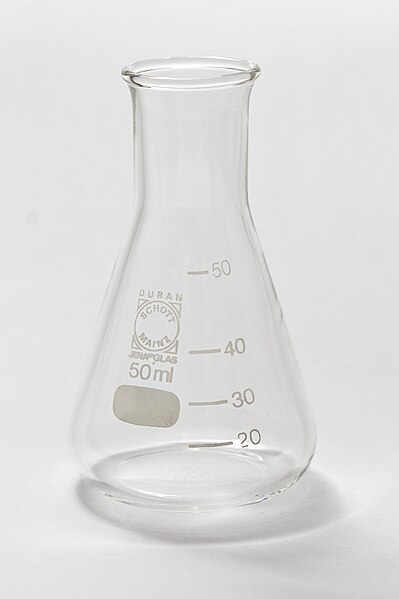
An Erlenmeyer Flask
(Photo by Lucasbosch and
used under the CC licence)
When learning one's way about the laboratory and it's equipment, it is easy to see how glasswares such as the volumetric flask and graduated cylinder got their names.  The Erlenmeyer flask, however, is not at all descriptive, which perhaps stems from the fact that an easy name including a suggestion of its use or shape would be hard to come by.  Maybe a swirling flask, or a narrow-neck flask?  But whatever else it could be called, what has come down to us in the lab today is the name of the flask's inventor, Emil Erlenmeyer.

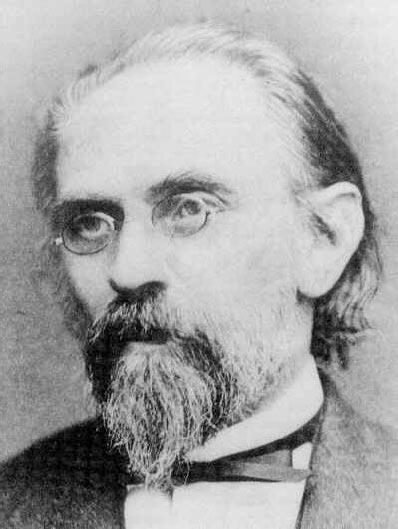
Emil Erlenmeyer
(1825-1909)
Erlenmeyer's full name was Richard August Carl Emil Erlenmeyer, so it is easy to see why he went with only Emil.  He began his studies as a chemist, and then turned to pharmacy in the 1840's and became an apothecary. Recall, however, that this was hardly a time of sophisticated medicine.  Florence Nightingale and her pleas for sanitation would not come until the next decade, and the effectiveness of the plethora of pills we have today was unheard of.

He returned to chemistry, however, and began on an academic career in German universities, studying at the University of Geissen and then becoming a professor at the University of Heidelberg.  I haven't been able to find a good story about how he created the Erlenmeyer flask, which he did in 1861, but since he was working in the lab experimenting with chemicals, it is easy to see why he did so. The shape has two main benefits: the shape, being wider at the bottom, makes it easier to swirl liquids without them splashing out, and the narrow neck reduces the amount of air exchange. He wasn't alone in working on improving laboratory equipment. Robert Bunsen, who had invented the Bunsen burner in the 1850s, was also a professor at the University of Heidelberg.

After invention of his flask, he had many more years to enjoy the fruits of his labors and the greater ease that the flask gave him in performing his experiments.  He published, according to a German website, at least twenty-seven articles, including several on cinnamic acid and other issues affecting organic chemistry.1   Another notable organic chemist was also working at Heidelberg when Erlenmeyer was there, August Kekulé, who was the first to write the structure of benzene as alternating double bonds.  The precise structure of molecules was a question that Erlenmeyer went on to study further.

Erlenmeyer's most memorable contribution to organic chemistry, though not as good for his name recognition as the flask, is "Erlenmeyer's Rule."  He developed this in the 1880s, by which point he was teaching at and retiring from the Munich Polytechnic School.  When I took organic chemistry, I don't recall this principle being called Erlenmeyer's Rule, though a quick literature search revealed that the name is still used.  Erlenmeyer's Rule says that if there is a hydroxyl group attached to a double bonded carbon, tautomerization will occur into the ketone or aldehyde form.  I wish I had known it had a name in organic chemistry, because I tended to forget this when writing the result of a reaction, and it would have been much better to blame it on a rule!

[1] DFG on Emil Erlenmeyer And if you are in Germany, you can register and read them for yourself! I, however, do not speak German and am now wishing that I did.