Showing posts with label Swedish. Show all posts

Sunday, April 15, 2012

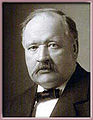
Svante Arrhenius: A Man of Many Interests

Svante Arrhenius
(1859 - 1927)
I'm sorry it's been awhile since my last post, but classwork caught up with me at last. I've been planning to write on Svante Arrhenius for two months now, when he came up in several homework assignments at the same time, and I expected this to be a simple post to write, since Arrhenius is best known, in my opinion, for his equation connecting the activation energy of a process and its kinetics. First, I found out that this was not the work for which he earned the Nobel Prize in Chemistry, and, more surprisingly, I discovered that he was also one of the first scientists to work out the effects of the greenhouse effect and he also postulated global warming resulting from human CO2 production. So between classwork, research, and Arrhenius being a more complicated person to write on than I though, this post has taken a while.  I will do my best to represent what Arrhenius actually wrote about global warming, but I can't read everything he wrote about the subject for this short post, so if you are curious, I would encourage you to look at some of his original writings, which are referenced and linked throughout.

Arrhenius was born in Vik, Sweden, in 1859.  His father was a land surveyor associated with the University of Uppsala, and the following year the family moved to Uppsala.  Here Arrhenius studied at the cathedral school, showing aptitude in mathematics.  He studied chemistry, physics, and mathematics at the University of Uppsala, but wanted a more rigorous physics education and went to Stockholm to study with Erik Edlund.  His work there resulted in his thesis, "Investigations on the galvanic conductivity of electrolytes."  This post's moral for graduate students is don't be discouraged if people think your ideas are wrong.  When Arrhenius submitted this thesis to the University of Uppsala, some of the professors were doubtful of its merit.  He proposed what is now universally accepted, that some chemical species dissociate in water into positive and negative ions, and that the degree of dissociation can depend on the concentration.  Michael Faraday (1791-1867) had already proposed ionic species, but only in the presence of an electric current.  In the end, his thesis was accepted.

One of the main proponents of his ideas was Wilhelm Ostwald (1853-1932), with whom Arrhenius was able to work as a result of a travel grant from the Academy of Sciences in the late 1880s.  He also worked with Ludwig Boltzmann (1844-1906), an Austrian physicist who was a proponent of the atom and a developer of statistical thermodynamics; Jacobus van 't Hoff (1852-1911), a Dutch chemist who studied, among other things, chemical kinetics and osmotic pressure; and Frederich Kohlsrauch (1840-1910), a German physicist also interested in the conductivity of electrolytic solutions.  Arrhenius's theory of electrolytes helped to explain some abnormalities in osmotic pressure data that van 't Hoff had found, and his discussions with these men enabled him to elaborate on his theory of dissociation to explain increases from the expected boiling point elevations and freezing point depressions in some materials by species dissociation.  These men were all instrumental in the formation of the modern field of physical chemistry. It was for this work, begun in his dissertation, that he won the Nobel Prize in Chemistry in 1903.

As I mentioned before, Arrhenius also studied the greenhouse effect.  The greenhouse effect, that the Earth's atmosphere can trap heat from the sun, had been proposed earlier by Joseph Fourier (1768-1830) in the 1820s.  John Tyndall (1820-1893), proved that both water and carbon dioxide can act as what we now call greenhouse gasses.  Arrhenius took their ideas and applied them to the question of whether the cycles of ice ages could be explained by changes in carbon dioxide in the air.  He did the extensive calculations to show that if the amount of carbon dioxide in the air doubled, the temperature of the earth would increase by five to six degrees Celsius.  He published these findings in the the Philosophical Magazine and Journal of Science under the title "On the Influence of Carbonic Acid in the Air upon the Temperature of the Ground" in 1896.  He had worked with his friend Arvid Högbom (1857-1940), a professor of geology at the University of Uppsala, who had considered carbon dioxide cycles over time.  Arrhenius went further, and in his book Worlds in the Making (1908, p. 54), suggested that the burning of coal could be leading to an increase in carbon dioxide in the atmosphere, though much of it is absorbed into the oceans.

Arrhenius lived for thirty more years and did many more things, including being the head of the Nobel Institute for Physical Chemistry.  But, I've gone on for a bit about him already and hit some of the highlights, so I'm going to stop here.  If you are still interested in Arrhenius, you might want to look up his writings on popular science (including Worlds in the Making and Life of the Universe); his work on hydroelectric power, the electrification of the Swedish railroads, and immunochemistry; and his successful efforts to obtain the release of scientists made prisoners of war during World War I.  But to touch on those would mean more for you to read, and, more importantly, more for me to research, so I will leave Arrhenius with that.


Other works by Arrhenius


References and further reading

Friday, January 6, 2012

Celsius and the Centigrade

Anders Celsius
(1701-1744)
There is quite a bit of confusion in the United States about what the temperature is.  Today, for instance, I'd tell someone that it was forty-two degrees.  But if I told that to one of my international friends, she would look at me funny and, perhaps, begin working on a conversion from Fahrenheit.  Some true-blooded Americans also use the Celsius scale to give temperatures, as do most European countries.  But that isn't the end of it.  Some people, when asked which scale they just gave a temperature in, might say "centigrade," which just adds another term to the confusion.

The first part of this confusion originated in the eighteenth century, when two men, Anders Celsius and Daniel Fahrenheit, both developed thermometers with different scales.  Theirs were not the first, however. Galileo is usually credited with inventing the first thermometer, in 1592, but he did not develop a memorable scale to go with it.  In the seventeenth century, liquid thermometers were developed and could be made quite accurately, but no standard scale had come into use.  In the 1660s, Robert Hooke developed a thermometer scale that went from -7 to 13, and many other scientists also developed temperature scales.

Anders Celsius was a Swedish astronomer.  As a professor at the University of Uppsala, starting in 1730, he spent a lot of time making measurements.  In 1730 he published a paper on a new method of determining the distance of the earth from the sun, and in 1736 he participating in an expedition to Lapland to measure the arc of a meridian.  In conjunction with another expedition to Peru, this measurment confirmed Newton's theory that the earth bulges slightly in the middle.  He also measured the brightness of stars by seeing how many layers of a thin film it took before the light disappeared.  With the strength of these measurements behind him, he persuaded the University of Uppsala to let him build an observatory, which was completed in 1741.  This was the same observatory that Anders Ångström would be in charge of over a hundred years later.

None of those measurements would seem to necessitate having a thermometer, however, and this is in part because his job description as astronomer is different from what we think of today. Certainly measuring the distance of the earth from the sun falls under astronomy, but back in the eighteenth century, so did measuring distances like the arc of a meridian, the changes in the height of seawater, and more meteorological measurements, including temperature. Celsius developed his scale by setting the boiling point of water at 0 and the freezing point of water at 100.  He called the units "centigrade", because the distance between those points is divided into one hundred equal steps. This was not radical, as that was the way most scales were created--by choosing two points and putting a certain number of degrees between them.  Celsius took his study of temperature one step further. He was not content with just making a thermometer that worked in Uppsala, but wanted to better understand the nature of temperature and make sure that it was independent of location.  By making measurement in many places, along with measuring the atmospheric pressure, he determined that the freezing point, but not the boiling point, was independent of pressure, though neither depends on latitude.  He published a paper reporting his results entitled "Observations on two persistent degrees on a thermometer" in 1742.  He died only two years later of tuberculosis.

If you were paying attention when I mentioned what the two points of his scale were, you will notice that his scale went backwards from what it does today--the boiling point of water is 0 and the freezing point is 100.  The switched scale, as we know it today, was made popular by Carl Linnaeus, the Swedish botanist famous for originating the biological nomenclature used today.  He made measurements of the conditions in which plants grow, and for  him, the freezing point of water was vital, since many plants die below that temperature.  In a paper published in 1745, only a year after Celsius's death, he used the same size of a degree and the same fixed points as Celsius, but placed 0 at the freezing point of water and 100 at the boiling point.  The modern Celsius scale was born.  Well, not quite.

Celsius had called his scale the centigrade scale, and it continued to be called that for centuries.  It was not until 1948 that the Ninth General Conference of Weights and Measures renamed degrees centigrade degrees Celsius, and caused even more confusion.  So the next time someone says "degrees centigrade," they aren't wrong, per se, just outdated.

Sources and further information:
Temperature Scales from the early days of thermometry to the 21 st century
History of the Celsius Temperature Scale
Anders Celsius
Linnaeus' Thermometer

Tuesday, December 13, 2011

Anders Jonas Ångström and the ångström

Anders Jonas Ångström
(1814-1874)
As any good chemist knows, an ångström is equal to 1x10⁻¹⁰ meters and is designated by the symbol Å, complete with the little circle on top.  I’ve often wondered where the circle came from,1 but surprisingly until starting this blog had not wondered if the angstrom was named after a person, especially since it does not follow the metric system prefixes.  Anders Jonas Ångström was born in Sweden in 1814 and studied physics at the University of Upsala.  He didn't leave except for brief sojourns to further science.  He was interested in astronomical work, and studied at the Stockholm Observatory before becoming the observer at the Upsala Observatory.  The Stockholm Academy of Sciences gave him the job of analyzing the magnetic data obtained by the “Eugéne,” a ship which had travelled around the world from 1851-1853.  In 1858 he became chair of the department of physics at Upsala University (I told you he didn’t leave).

Ångström is most known, when he is thought of at all, for his work in optics which led him to be considered one of the founders of spectroscopy.  His work was primarily with things that gave off light, such as electric sparks. His greatest work was with the solar spectrum, and it is from this work that his fame as the namesake of the ångström comes.  By studying the wavelengths of light emitted by the sun using diffraction gratings, he determined in 1862 that the sun’s atmosphere contained hydrogen.  In 1868 he published a book containing a map of the entire visible solar spectrum, consisting of 1000 lines: Recherches sur le spectre solaire.  Others doing similar work used arbitrary units, but Ångström used units of ten-billionths of a meter, or at least he thought he did.  He discovered that the meter from which he measured the gratings was too short, and thus all of his calculations were off.2  He began the work to correct it, but died in 1874, before it was finished, leaving his assistant Thalén to finish the job.  A contemporary said that his “work [was] characterized by such accuracy and completeness as to render it worthy of the highest admiration, to be regarded as a pattern to all investigators.”3  Although others had attempted to make such maps, Ångström’s was the most complete and accurate, and so those who came after him used his units to describe future measurements, calling them at first Ångström units and then ångströms.

Ångströms, however, are not the best units for describing visible light, since they result in numbers in the thousands, such as 6534.  The wavelengths Ångström described are commonly now referred to in nanometers, so the values are only in the hundreds.  Chemists, however, have a great affinity for the ångström, since it is the perfect unit for describing the length of chemical bonds, which are on the order of an ångström.  So, although the angstrom is no longer used in the field in which it originated and has been relegated to the status of a “non-SI unit,” it still finds its uses in chemistry although Ångström and his work have been long forgotten.


[1] Upon further investigation, the ring is not a diacritical mark, but an integral part of the letter in Sweden.
[2] Some idea of the complication of the creation and recalculation of this map can be gathered by looking at the exercises in Robert Alexander Houstoun's  A Treatise on Light, p. 254.
[3] Heinrich Schellen, Spectrum analysis in its application to terrestrial substances, and the physical constitution of the heavenly bodies (Longmans, 1872), p. 237.  The figure is also from this book.
As a reward for reading the footnotes, here is a link to an argument that Ångström had with a fellow physicist in the Philosophical Magazine: "Observations on Certain Lines of the Solar Spectrum".  Note that the fellow who argues against Ångström, Pierre Janssen, doesn't have a unit named after him, but they both gave their names to (separate) lunar craters, and only Janssen has a crater on Mars.