Showing posts with label Engineers. Show all posts

Wednesday, July 31, 2013

Lord Kelvin: Beyond Degrees


William Thomson, Baron
Kelvin of Largs (1824-1907)
Painted by Hubert von Herkomer
It has been a little while since I wrote on someone who gave his name to a unit, so up this week is the eponym of the Kelvin, William Thomson, who is more often referred to as Lord Kelvin, because, for the last years of his life, he was Baron Kelvin of Largs. He did not inherit the title, but was actually the first scientist to be elevated to the House of Lords, and spent most of his life as William Thomson, although he was knighted in 1866, becoming Sir William Thomson. In addition to being the first Baron Kelvin, he was also the last, as he had no heir to succeed to the title. In just a bit of reading about him, I found out that Thomson/Kelvin was interested in all sorts of things, far more than just thermodynamics. These other interests include telegraph signals, navigational aids, and the age of the earth. I have become quite caught up in his and others work on the telegraph, so I initially intended to write this only on his telegraph work, but I have become so excited about telegraphy that I decided to give it a post all of its own. So this post will focus on Kelvin's work except for telegraphy, but look forward next week (hopefully) to a post all about the telegraph, and perhaps another post on Thomson.

So that I can skip on his scientific and engineering work, I'll give only a brief summary of William Thomson's life. He was born in Belfast and moved to Glasgow as a child. He studied at the Universities of Glasgow and Cambridge (where he was on the rowing team). At the young age of 22 he took a professorship at the University of Glasgow and never left, despite other offers. He gave many lectures, including a series at Johns Hopkins University. He also owned a yacht, the Lalla Rookh, built for him in the late 1860s, and several of his inventions were for improving navigation. He published more than 661 papers/communications and took out 70 patents. After his death in 1907, he was buried in Westminster Abbey next to Isaac Newton.
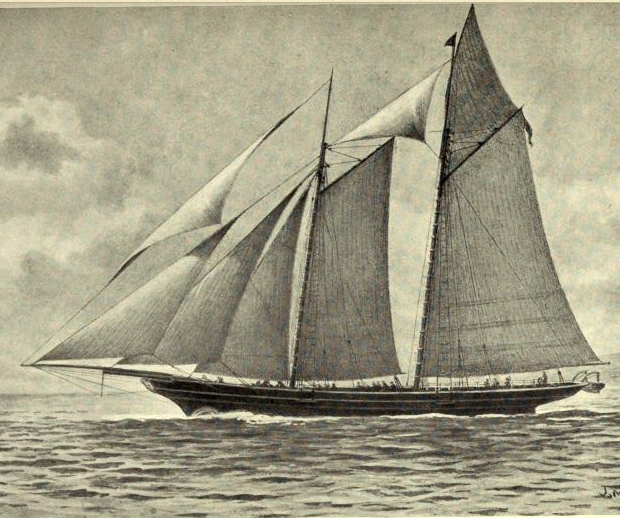
The Lalla Rookh
From The Life of William Thomson by Silvanus Thompson
The Lalla Rookh was a yacht of 126 tons. Thomson was known to take it out for much of the time between the semesters at the University of Glasgow, and sailed around Scotland and even farther afield, such as Lisbon. He also used it to entertain. In 1871 he planned a cruise to the Hebrides and West Highlands with Hermann von Helmholtz, Thomas Huxley, John Tyndall and James Maxwell, though it seems only Helmholtz was actually able to make it. Having the ship inspired twenty five different patented inventions. One of these was a device for correcting compasses when the ship had a metal hull. Another was an improved sounding (depth finding) device, using a wire rather than a rope such that measurements could be taken at speed.

The purchase of the ship may also have lead to his increased interest in fluid mechanics, which occurred in 1867, and was one of the subjects he discussed with Helmholtz on their journey in 1871. But his interest in fluid mechanics had a little remembered result as well--the idea of vortex atoms. Remember, the structure of the atom was not known in the mid-19th century. A common standard for atomic weights was not determined until 1860, and Mendeleev published the first periodic table in 1869. Even then, people didn't know what made up an atom. J. J. Thomson discovered the electron in 1897, and Rutherford's famous experiment which proved the existence of an atomic nucleus was not until 1909, after Kelvin's death, so the question of the nature of the atom was wide open. William Thomson spent considerable time developing the idea of vortex atoms, based on the descriptions of fluid motion made by Helmholtz, who had expanded descriptions of fluid motion to include more irrotational motion. This theory suggested that atoms are vortexes (such as smoke rings) in the ether that makes up space. By around 1883, Thomson began to feel that his theory was not sufficient to explain matter, but he had gotten other scientists thinking about the idea and furthered the field of hydrodynamics.

There is certainly more to be said, and I had hoped to say it, but hopefully that whets your appetite and you will go looking for more information on your own. The references should be quite helpful. And perhaps I will return to Kelvin at some point to talk about absolute zero, electricity, and the age of the earth. But if I try to cover them now, this post will never be finished.


Miscellaneous Works by Thomson
References

Thursday, February 2, 2012

Diesel and His Engine

Rudolf Diesel
(1858-1913)
I've been hoping to find a scientist or engineer with an interesting story, and I think I found one. I was looking for information on how to synthesize monoglycerides, and discovered that the process is similar to making bio-diesel, which then begs the question (at least to me), what is diesel and why is it called that?

Rudolf Diesel invented the diesel engine, and thus in a remarkable fit of (probably) proper attribution, has his name attached to it. He is an interesting character, because he wanted to improve the efficiency of engines and change the world, a vision that I think few engineers really believe in today.

Diesel had a disjunct childhood.  He was born in Paris to Bavarian parents in 1858, but was sent to school in England in 1870 as a result of the Franco-Prussian War.  Less than a year later, he was sent to the Technical School in Augsburg, Germany.  He graduated from the Techincal University in that city in 1880, and began working with Carl von Linde (1842-1934) in Munich. Von Linde had recently developed a method for refrigeration using ammonia and was therefore very interested in the studies of heat.  In 1895, he even succeeded in liquefying air.1

Drawing from Diesel's apparatus for
converting heat into work,
US Pat. #542846
Working with von Linde, Diesel was able to work on a problem that he had begun considering when an undergraduate.  Steam engines were more efficient when large, so Diesel set out to develop an engine that would still be efficient when small. He was particularly interested in the ideal engine envisioned by Sadi Carnot (1796-1832) and descrived in 1824, called the Carnot cycle. At first, Diesel designed an engine similar to a steam engine that ran on ammonia, but, though the engine did work on a smaller scale than steam, he ran into problems like leakage.  He then considered a case in which the combustion of the fuel took place in a cylinder of the engine, rather than in a boiler.  Nikolaus Otto, a German engineer, had created the first marketed internal combustion engine in 1862, so this idea was not new.  What made Diesel's engine different was that it did not need a spark to ignite the fuel, but used higher compression ratios than the existing internal-combustion engines, leading to self-ignition. It was this isothermal combustion that set the diesel engine apart.

Diesel worked on models of the engine at the Augsburg-Nuremburg Engine Works with its financial backing and that of Krupp (a company that still exists today as ThyssenKrupp).  One of the greatest challenges was creating chambers that could withstand the large pressures that Diesel required for combustion. After four years of testing and various accidents, Diesel and his manufacturing aides created a working prototype engine in 1897. The engines got off to a rocky start.  Diesel tried to market his invention immediately, but there were still some kinks to work out.  Several accidents making dents in Diesel's profits from the patents he had taken out (see the list in references for more information).

Diesel had a larger vision for his engine than just making it more efficient. He thought that his engine could transform society. Since his engines worked on a smaller scale than the steam engines, they could be used by small craftsmen and help to counteract that increase in the scale of manufacturing resulting from the industrial revolution.  Diesel was part of a movement that believed that technology could save the world.  Rather than having the workers rise up as Marxism called for, he believed that technology could better the lot of workers and narrow the class divide, so such a revolution would not be necessary.  He did, however, believe in a form of communism in which workers would pool their resources for the greater common good.  He presnted his ideas in a 1903 book entitled Solidarismus: Natürliche wirtschaftliche Erlösung des Menschen (Solidarity: The Rational Economic Salvation of Mankind).  

In 1912, questions about whether Diesel actually invented the diesel engine came to a head.  Some people argued that credit needed to go to the factory assistants, rather than Diesel.  When a history of the diesel engine was to be published, Diesel preempted whatever it might say about him by presenting a paper explaining his development of the engine at the German Society of Naval Architects.  This might seem a strange place to give such a paper, but the main use of diesel engines at that point was in ships.

The following year, Diesel was crossing the English channel and went overboard during the night.  This incident led to much speculation about how he died, though the most likely explanation is that he committed suicide.  The most interesting story that I came across was that he was killed by the German secret service to prevent him from betraying secrets about submarines to the British.


1. Carl von Linde (back)

Holmgren, E. J., "Rudolf Diesel, 1858-1913" Nature 181, no. 4611 (1958), 737-738.
Bryant, Lynwood, "The Development of the Diesel Engine" Technology and Culture 17, no. 3 (Jul., 1976), 432-446.
Thomas, Donald Jr., "Diesel, Father and Son: Social Philosophies of Technology" Technology and Culture 17, no. 3 (Jul., 1978), 376-393.

List of Diesel's patents (back)
US Pat. #542846 Method of and Apparatus for Converting Heat into Work, filed August 26, 1892
US Pat. #608845 Internal-Combustion Engine, filed July 15, 1895
US Pat. #673160 Method of igniting and regulating combustion for internal-combustion engines, filed April 6, 1898
US Pat. #654140 Apparatus for Regulating Fuel-Supply of Internal-Combustion Engines, filed September 10, 1898

US Pat. #736944 Internal-Combustion Engine, filed November 1, 1899
US Pat. #RE11900 Internal-Combustion Engine, filed July 3, 1900
US Pat. #708029 Internal-Combustion Engine, filed January 18, 1901
US Pat. #873926 Longitudinally-Displaceable Car-Body for Motor-Vehicles, filed January 25, 1908